Research
Representation Learning for Real-World Sequential Data
A central question across my research is: what kind of representation preserves the structure that remains informative across users, contexts, and changing conditions? I study this through work on real-world sequential data, especially in settings where observations are noisy, limited, temporally structured, and constrained by sensing and deployment realities.
Across textile sensing, conversational behavior, and physiological time series, I use prediction both as a performance target and as a test of whether the learned representation captures structure that is predictive, interpretable, and stable across conditions. These domains are specific, but the methodological questions extend beyond them: how to learn representations that remain informative under temporal variation, partial observability, and distribution shift? These questions continue into the future directions outlined in the Research Outlook at the end of this page.
Research themes
Representation learning under limited observability
Much of my work focuses on signals that provide only partial access to the underlying phenomenon. I study how representation design can recover stable, discriminative structure from sparse, noisy, or incomplete observations across users and sensing conditions.
Temporal modeling under real-world variation
Many of the signals I work with are meaningful because of how they unfold over time rather than through static summaries alone. My work therefore emphasizes sequential representations and temporal models that capture dynamic structure while remaining useful across variation in users, environments, and interaction patterns.
Generalization beyond controlled settings
I am especially interested in whether learned structure remains valid under realistic sources of variation: new users, new environments, physical deformation, natural interaction, and distribution shift. This appears throughout my work in cross-subject evaluation, zero-calibration inference, robustness analysis, and deployment-aware modeling.
Systems-aware machine learning
I approach ML as part of a larger system that includes sensing, preprocessing, representation design, model architecture, and deployment constraints. In many of my projects, hardware limitations and real-world operating conditions are not secondary details—they are part of the learning problem itself.
Selected Contributions
- Introduced invariant signal representations for sparse multi-channel textile sensing, increasing group separability by 39× and reducing pairwise comparison time by roughly 50×.
- Showed subject-independent touch localization on a 36-button knitted sensor surface without per-user calibration.
- Developed temporal models for 12-class gesture recognition from limited textile sensor inputs, reaching 89.8% accuracy under sensing constraints.
- Built interpretable temporal representations for naturalistic social-behavior analysis, focusing on clinically meaningful structure in conversational head dynamics.
- Developed subject-aware machine-learning pipelines for noisy physiological time series, extending representation learning to structured biological signals.
Interactive Textile Sensing: Learning from Sparse Signals
Research agenda
My knitted-sensor research explores how computational modeling can enable digitally knitted textile substrates to function as a general interactive sensing platform: soft, low-profile sensor designs that recover human intent through touch and gesture and support downstream interactive applications built on top of that inference.
Across this work, the central question was not simply whether a classifier could perform well, but how far representation learning and temporal modeling could extend the capabilities of minimally wired textile hardware while preserving manufacturability, robustness, and usability. At the ML level, this research uses textile sensing as a concrete setting for studying learning under limited observability: how much useful structure can be recovered from sparse, physically constrained, real-world signals without simply adding denser instrumentation?
Across four papers, that question evolved in both scope and difficulty. The work moved from invariant representation and sequence comparison for sparse touch signals in Vallett et al. (EICS 2020), to precise touch localization on a 36-button surface in McDonald et al. (IMWUT/UbiComp 2021), to complex multi-class gesture recognition on a more expressive sensor configuration in McDonald et al. (arXiv 2023).
A formative study with 32 users in McDonald et al. (CHI 2022) sits between the localization and gesture-recognition work as a bridge between system vision and technical modeling. It validated the broader platform agenda against real user expectations, identified gesture capability and physical durability as baseline requirements, and translated those requirements into concrete modeling and robustness questions that the later gesture-recognition work addressed directly.
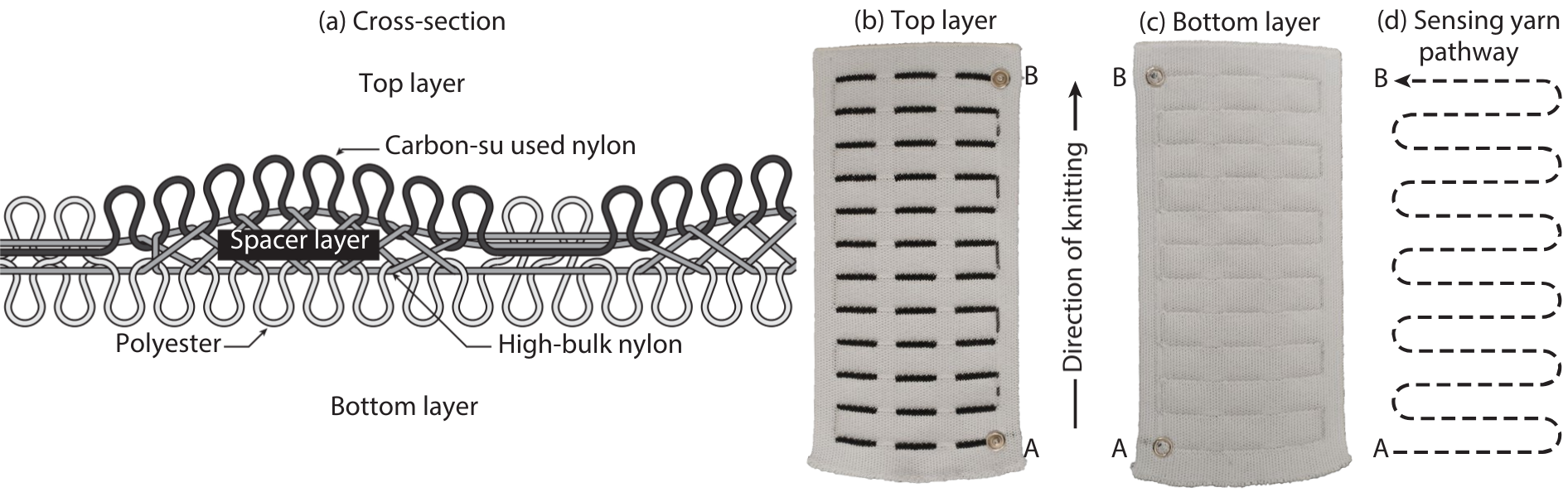
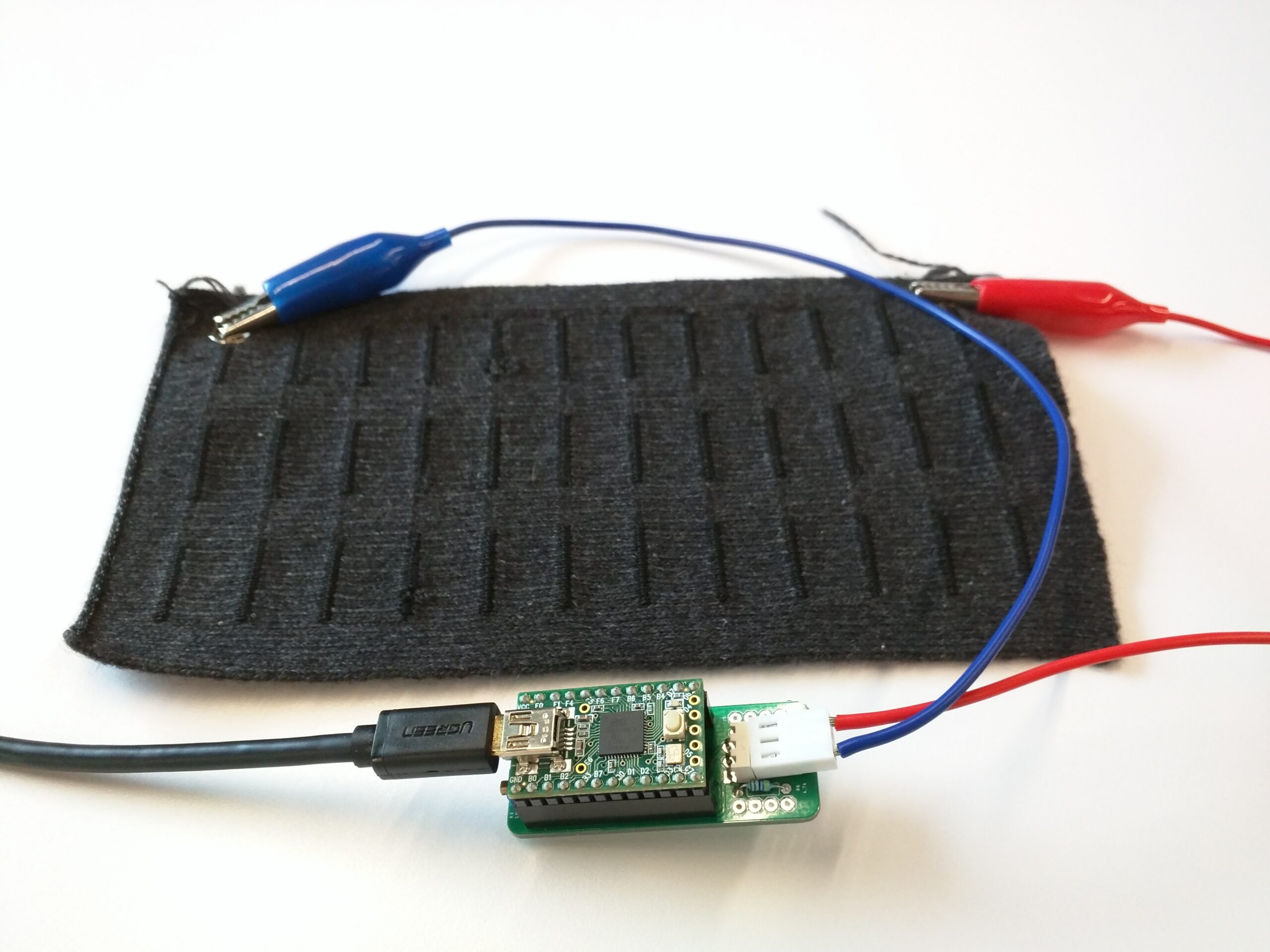
Digitally knitted capacitive sensors. Left: sensor design and construction. (a) Illustration of the layered structure formed by digital flatbed weft knitting with conductive carbon-coated nylon yarn and non-conductive polyester yarns. (b) Top layer of a completed sensor, with darker lines indicating touch areas. (c) Bottom layer of the completed sensor. (d) Serpentine conductive-yarn pathway formed by the knitting process. Right: real-time sensing controller connected to a knitted sensor through electrodes at the yarn endpoints. From McDonald et al. (IMWUT/UbiComp 2021). Figures by Richard Vallett, Center for Functional Fabrics, Drexel University.
Invariant representation and sequence comparison
Textile sensing poses a difficult representation problem: the raw signals are sparse, multi-channel, and temporally variable, yet subtle differences in touch structure still need to remain recoverable across interactions. The first step in this research agenda was therefore not to scale up hardware, but to ask whether better representation and comparison methods could make minimally wired sensing substantially more informative.
A central technical theme in this work was designing representations and metrics that remain informative despite sparse hardware and signal variability. In Vallett et al. (EICS 2020), I developed Mixed-Source Description (MSD) as a sparse, SIFT-inspired representation for multi-channel signals that captures salient local invariances rather than relying on brittle raw sample-wise comparison. The goal was to preserve the parts of the signal most stable under timing variation, deformation, and local shape differences while producing a shorter, more discriminative representation.
The discriminative improvement was substantial. Evaluated with ELD—a custom sequence distance metric introduced in the same paper—on a 36-button touchpad dataset collected from 13 subjects, raw signal representations yielded an ANOVA f-statistic of 58.26 (p = 0.00) for separating same-location from different-location key-presses. MSD raised that to 2,279.20 (p = 0.00), an approximately 39× increase in group separability, while also reducing conflation between nearby buttons. The heatmaps below make this visible: the diagonal sharpens and the off-diagonal structure clears substantially under MSD.
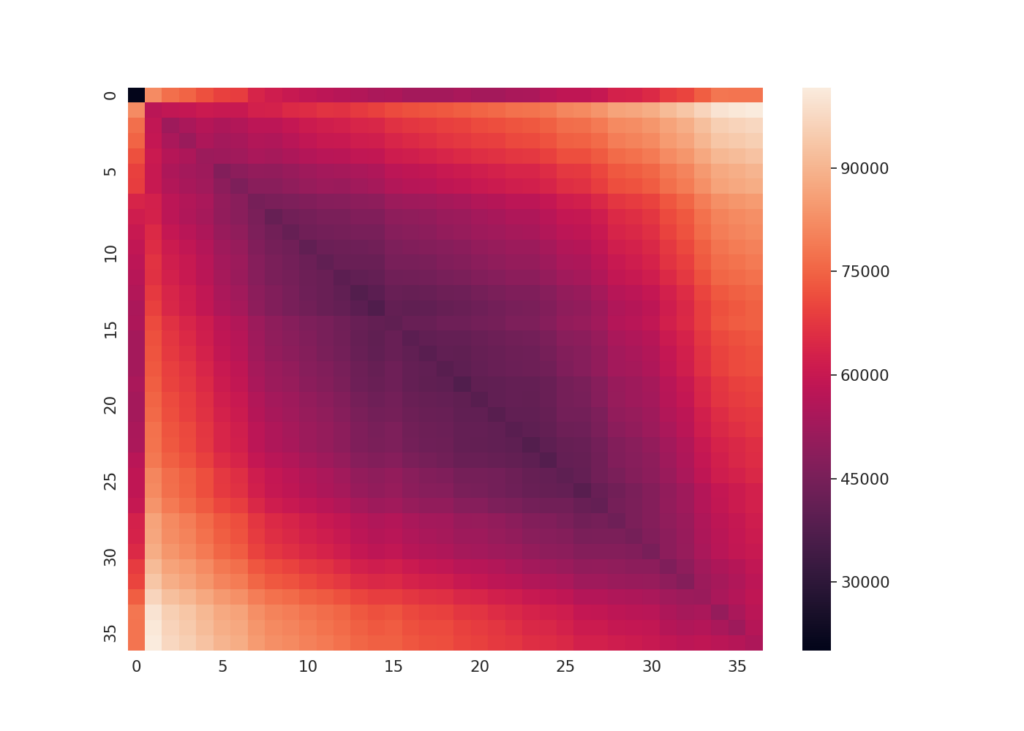
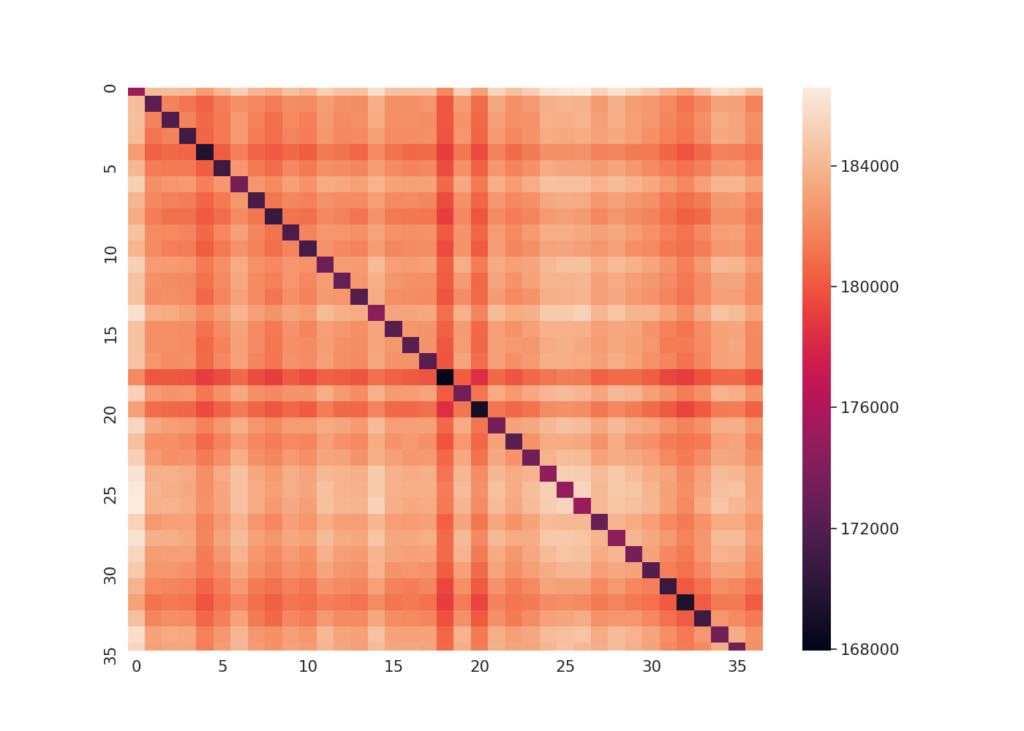
Pairwise touch-location distance matrices computed using ELD across 210 key-presses per button on a 36-button knitted touchpad (13 subjects). Lower diagonal values indicate stronger within-class similarity. Left: raw signal representation (f-statistic 58.26). Right: MSD representation (f-statistic 2,279.20). The sharper diagonal and cleaner off-diagonal structure under MSD reflect the approximately 39× increase in group separability. From Vallett et al. (EICS 2020).
MSD’s sparsity also had an important computational consequence. Computing the full pairwise distance matrix for one subject’s data took approximately 17 hours under the raw signal representation and approximately 20 minutes under MSD, a roughly 50× reduction in processing time on identical parallel hardware. This mattered not only as an efficiency result, but as evidence that sparse representation was a meaningful design choice for downstream analysis and any future deployment pipeline operating over variable-length sequences.
In the same work, I introduced Euclidean Levenshtein Distance (ELD) as a sequence metric that extends edit-distance logic to continuous multi-dimensional signals. Instead of treating sequence comparison as exact match versus mismatch, ELD computes Euclidean costs between temporally ordered descriptors, allowing flexible alignment while preserving sequential structure. This made it better suited than fixed-length vector distances for human-generated signals whose timing naturally varies.
ELD was designed to be reusable beyond a single experiment, and that generality appears in later work. In McDonald et al. (CHI 2022), I used it again to analyze similarity among swipe and accidental-contact samples on a different sensor configuration, showing that the metric transferred across sensing substrates and interaction types rather than being tied to a single dataset.
Feature construction and temporal modeling for touch localization
This work was conducted in close collaboration with Richard Vallett, who led the real-time signal acquisition hardware and embedded sensing pipeline. My primary contributions were the representation strategy, modeling architecture, experimental evaluation, and the analytical framework connecting sensing constraints to modeling decisions.
In McDonald et al. (IMWUT/UbiComp 2021), the research advanced on two fronts at once: a real-time signal acquisition and processing system, and a model that could identify precise touch location on a knitted sensor without user-specific calibration. Where Vallett et al. (EICS 2020) had established invariant representation and variable-length sequence comparison, this work moved to direct touch localization in a real-time embedded pipeline. Swept-frequency Bode analysis across 96 frequencies, rather than the single input frequency used earlier, provided a richer characterization of the signal at each time step and shaped every downstream modeling decision. Hardware and acquisition details are covered more fully on the Systems page.
Representation strategy
The central modeling contribution was to construct compact, stable features from the multi-frequency signal before temporal modeling rather than passing raw gain values directly to the model. At each of 250 time steps in a key-press, I computed statistical summaries over the full frequency response of each electrode, capturing central tendency, spread, and linear trend in a representation more stable than raw per-frequency magnitudes. Baseline subtraction removed constant ambient components and preserved interaction-specific structure.
The resulting 250×16 representation for each key-press remained temporally ordered, which is precisely why an LSTM was the right modeling choice: the problem was not classifying a static feature vector, but recognizing how a press unfolded over time. Feature construction steps and LSTM architecture are detailed on the Systems page.
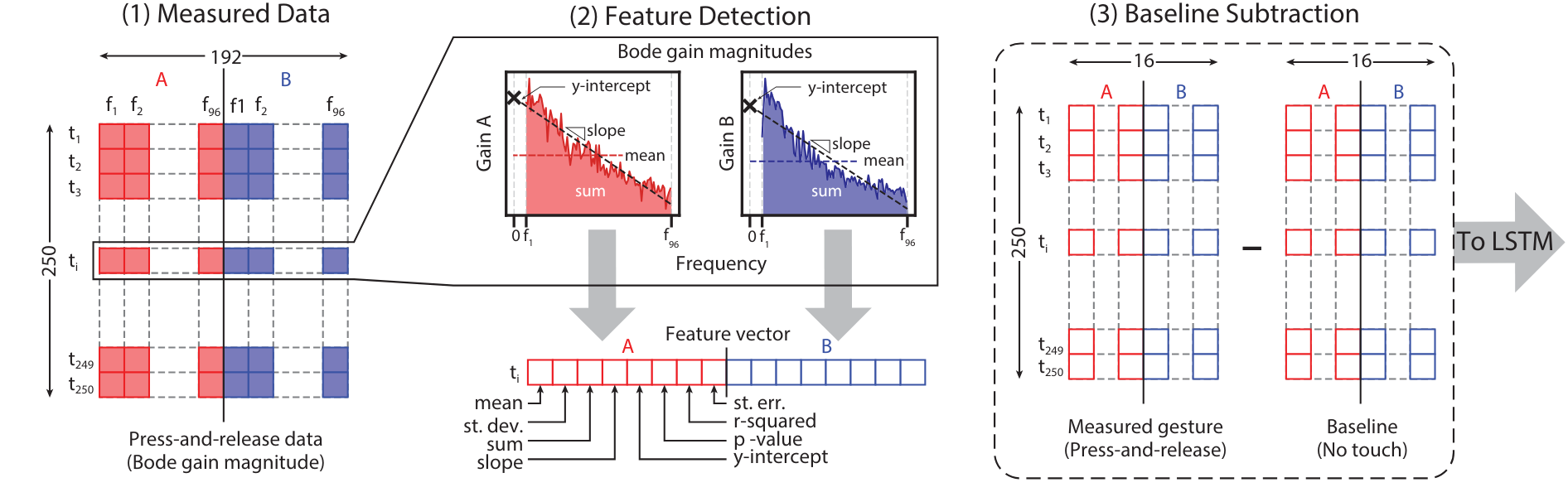
Feature construction over frequency gain values of signals from both electrodes: (1) the raw data is composed of 250 time instances and 96 frequency values per signal, for a total of 192; (2) statistical features are computed over the frequencies per time step; (3) baseline is subtracted from key-press data. From McDonald et al. (IMWUT/UbiComp 2021). Figure in collaboration with Richard Vallett, Center for Functional Fabrics, Drexel University.
Benchmark structure
The benchmark design was deliberate: each comparison isolated a specific modeling claim. Replacing multi-frequency features with single-frequency raw input reduced accuracy to 25.3%, testing whether swept-frequency feature construction added value. Replacing the LSTM with a non-temporal MLP reduced accuracy to 46.3%, testing whether temporal modeling mattered independently. Both degradations were substantial, showing that feature construction and temporal modeling were each necessary rather than one compensating for the other. Full benchmark results are discussed in more detail on the Systems page.
Zero-calibration design
All evaluations were conducted subject-independently, with no per-subject calibration. This was a deliberate design choice: calibration would likely improve accuracy, but it would also make multi-user interaction intrusive and reduce real-world scalability.
The evaluation was structured in three studies. Study 1 established model performance through cross-validation across 24 subjects. Study 2 tested generalization on 7 entirely new subjects who contributed no training data. Study 3 evaluated zero-shot robustness under EMI and stretching using the same trained model. Separating the evaluation this way made it possible to test generalization and robustness explicitly rather than collapsing both into a single held-out result.
The system achieved 66% subject-independent accuracy on a 36-button touchpad, with chance near 3%. Held-out evaluation exceeded cross-validation accuracy, indicating stable generalization rather than subject-specific overfitting.
Sensor design exploration
The paper also introduced multiple new sensor designs — including game controllers, a piano keyboard, a volume slider, and media-control buttons — and compared their gain-separation profiles across different yarn-routing geometries. This established a principled relationship between textile design choices and sensing performance.
Designs with larger conductive areas and greater inter-touchpoint resistance produced more analytically separable signals. The 36-button touchpad used for all modeling experiments was deliberately the most difficult case, with low inter-button resistance and a dense serpentine layout that minimized signal differences between adjacent locations. Demonstrating the modeling approach on the most challenging design made the results more broadly informative.
User Perspectives and Research Direction
In McDonald et al. (CHI 2022), I extended the research agenda in a direction that technical performance metrics alone could not answer: what users actually expected from this technology, what interaction capabilities it needed to support, and whether the physical substrate could withstand everyday use. This paper helped ground the broader platform vision in real deployment expectations rather than treating interaction quality as a purely technical benchmark.
Formative study
I conducted a formative study consisting of 8 focus groups with 32 participants, analyzing the data through thematic analysis. Participants interacted with multiple sensor prototypes and application demonstrations—including touchpads, sliders, a piano keyboard, game controllers, and a MIDI controller system—and were asked about their perceptions, desired applications, and hesitations.
Several substantive themes emerged. Participants understood the technology through its identity as fabric: texture, softness, portability, robustness, and low production cost shaped which applications they found compelling and which user populations they imagined benefiting most. They also envisioned three broad classes of applications: familiar interfaces reimagined in fabric form, ambient integration into everyday environments, and body-proximate sensing for health, occupational, and assistive use.
Participants also raised concrete design and system-level expectations. They valued unobtrusive appearance, cared about style and color variation enabled by the manufacturing process, and had specific views on size and thickness tradeoffs across contexts. Just as importantly, they expected hardware minimalism and connectivity with existing devices, reasoning about the sensor as part of a broader interactive system rather than as a standalone novelty.
Most importantly, a distinct concerns cluster emerged around accuracy, safety, and everyday reliability. Participants repeatedly asked whether gestures beyond simple taps would be supported, whether the sensors could survive washing and stretching, and whether incidental contact during ordinary use would trigger false interactions. These were not abstract concerns: they defined concrete functional requirements without which adoption would be unlikely.
Together, the study produced 10 design guidelines for application designers working with this technology, addressing texture, comfort, scalability, target user groups, modularity, and communication of safety properties. More importantly for the research agenda, it clarified which technical questions mattered most next.
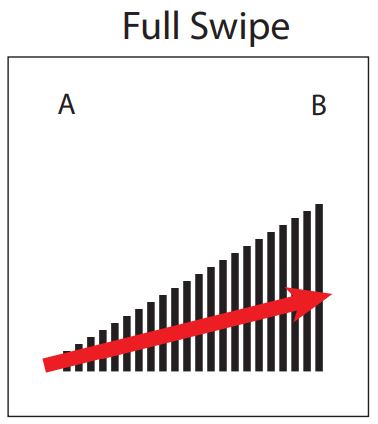
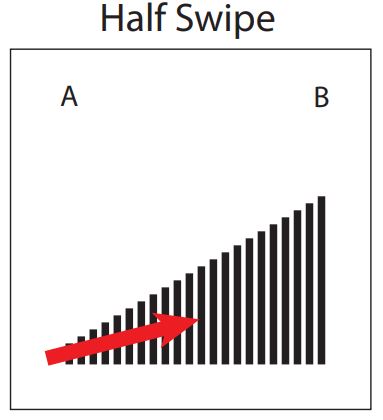
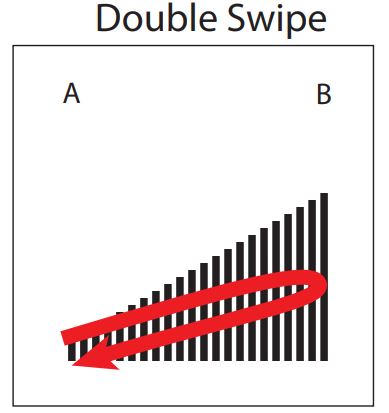
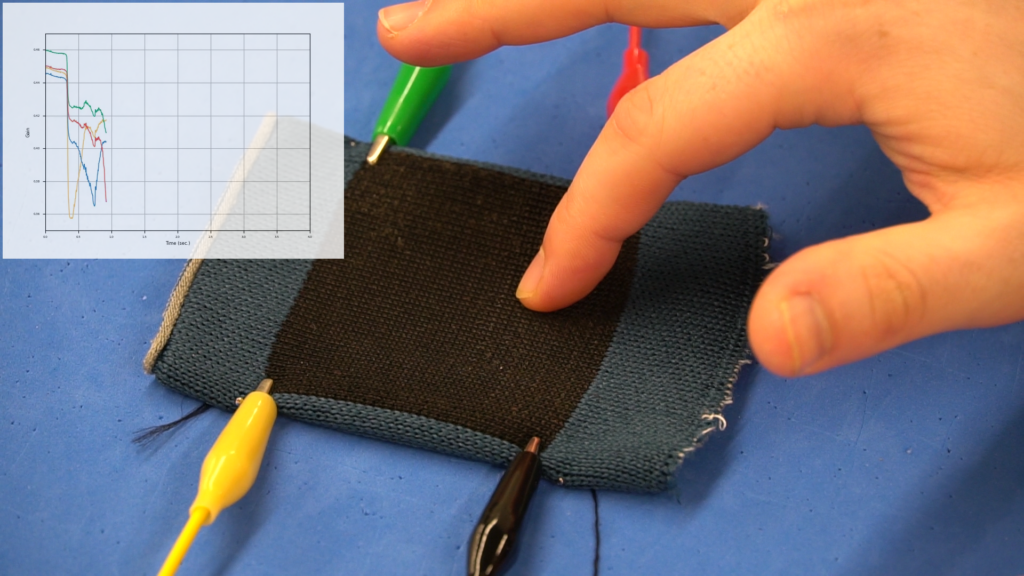
Four interaction classes for gesture-level signal separability evaluation. The first three — full swipe, half swipe, and double swipe — have similar but distinct trajectories, chosen to test whether overlapping motion primitives remain distinguishable at the signal level. The fourth, random contact, captures accidental touch during everyday use: participants simulated incidental contact without a prescribed trajectory. Its inclusion reflects a deliberate stance: separating intentional interaction from accidental perturbation is a human-centered inference problem, not merely a signal-processing problem. From McDonald et al. (CHI 2022). Figures by Richard Vallett, Center for Functional Fabrics, Drexel University.
Research questions generated
Two user concerns translated directly into follow-up experiments within the same paper: whether closely related intentional gestures—swipe, half-swipe, and double swipe—could be distinguished from one another and from accidental contact, and whether the physical substrate remained stable under everyday use conditions including washing, drying, and stretching. These experiments are covered in more detail on the Systems page, but their role here is important: they show that the formative study functioned not just as contextual framing, but as a way of prioritizing the next inference and robustness problems the system needed to solve.
The next step in the agenda was therefore not simply better classification, but richer interaction modeling under more demanding conditions. That led directly to the question of what it would take to recognize complex, multi-class gestures in a deployable system: requiring a more capable sensor design, a stronger spatiotemporal architecture, and broader attention to robustness and deployment feasibility.
Spatiotemporal modeling for gesture recognition
In McDonald et al. (arXiv 2023), the research question shifted from localizing static touch events to recognizing complex continuous gestures. That transition required rethinking the sensor design, signal-processing strategy, and modeling architecture together. The earlier 2-electrode serpentine configuration was not sufficient for this task: its non-uniform resistance gradient and sparse touch areas fragmented continuous gesture trajectories, motivating a move to the 4-electrode planar design described on the Systems page.
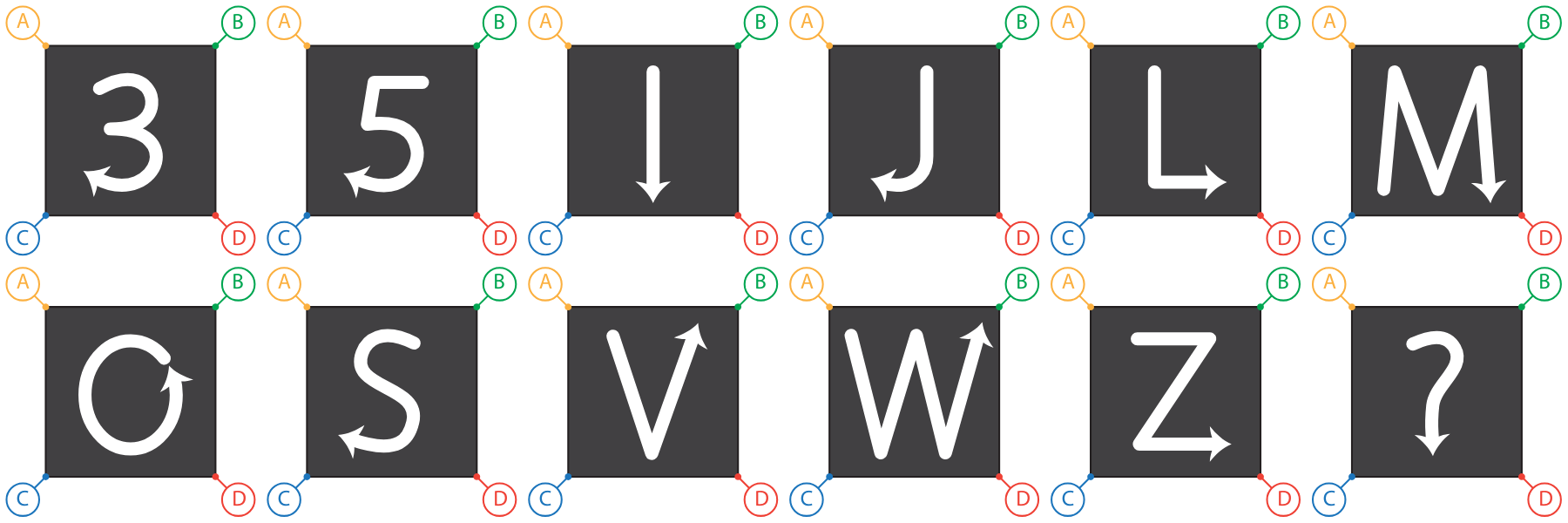
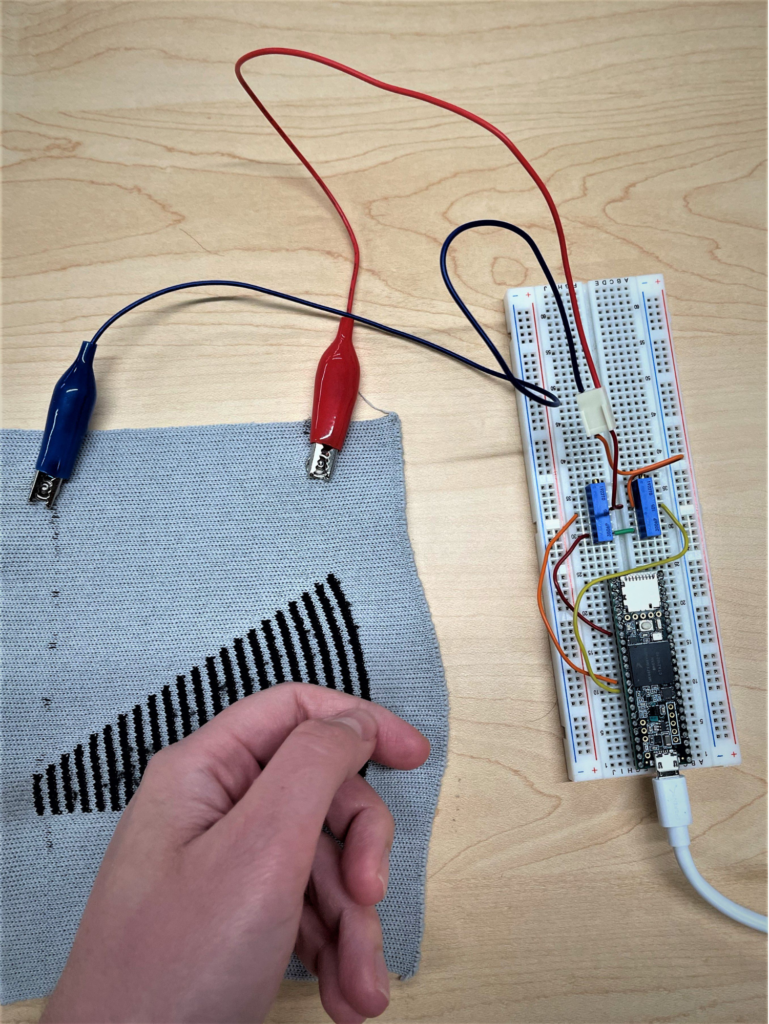
Pathways of the collected gestures. Left: The knitted component of the sensor on which the gestures were performed; Right: All the gesture pathways that were collected and analysed. From McDonald et al. (arXiv 2023). Figures by Richard Vallett, Center for Functional Fabrics, Drexel University.
Gesture set
The 12 gesture classes—3, 5, I, J, L, M, O, S, V, W, Z, and ?—were selected on principled criteria. Each could be performed as a single continuous motion with a distinct onset and offset; they varied deliberately in complexity from simple (I) to complex (?); and they included similar pairs such as S and 5 and V and W to test whether the system could discriminate gestures with substantially overlapping motion primitives.
The set was also designed as a first step toward a broader alphanumeric recognition system and, more generally, toward fabric-based communication interfaces, rather than as a convenient sample of gestures.
Signal processing and architecture
Rather than constructing hand-engineered statistical features as in the earlier 2-electrode pipeline, the 4-electrode system passed baseline-subtracted, wavelet-filtered signals directly to the model. This shifted more of the representation burden from manual feature construction to learned spatial extraction.
That architectural choice (CNN-LSTM) followed from the signal structure itself. At each time step, the four-channel gain measurement contained meaningful spatial structure: the relative attenuation pattern across the four corner electrodes encoded where on the surface the gesture was occurring. A CNN was therefore well suited to extracting that local spatial structure. Its translation-tolerant behavior helped capture consistent patterns across users who placed their fingers slightly differently, while composing those local patterns into higher-level features without requiring them to be hand-specified.
The LSTM then operated over that learned spatial representation across the 250-frame gesture window, modeling how the pattern evolved over time: the trajectory, velocity, and directional changes that distinguished one gesture from another. Neither component alone was sufficient. Spatial extraction without temporal modeling could not represent gesture trajectories, and temporal modeling without spatial extraction could not recover the structured location information encoded in the four-channel signal. The benchmark results support this interpretation, and fuller ablation details are on the Systems page.
Results
The system achieved 89.8% held-out evaluation accuracy and 78.6% cross-validation accuracy across 12 gesture classes, both subject-independent and without per-subject calibration. The fact that held-out accuracy exceeded cross-validation accuracy is consistent with the generalization pattern observed in the 2-electrode system and supports the interpretation that the model learned stable structure rather than overfitting to training subjects.
Toward deployable interaction
The broader contribution of this work was moving toward an interactive system architecture: offline data collection and model training, deployment on compact embedded hardware, real-time classification, and application-layer interpretation. This required treating deployment feasibility, on-body robustness, and durability under repeated laundering as first-class research questions from the outset; those results are discussed on the Systems page.
The work therefore demonstrates a path from minimalistic textile hardware to a deployable gesture-recognizing interactive system, extending the platform vision established in McDonald et al. (CHI 2022) into a functioning technical implementation.
What this work shows
This research demonstrates a broader principle: interaction capacity in physically constrained systems depends not only on hardware, but on representation design, temporal modeling, and evaluation under realistic variation. Across this work, increasingly sophisticated interaction—from coarse touch discrimination, to precise localization, to complex gesture recognition—was achieved primarily through advances in representation and architecture, with hardware scaling playing a secondary and deliberate role.
McDonald et al. (CHI 2022) add something that purely technical work cannot: evidence that this design philosophy aligns with real user expectations, that the application space is broad and user-identified rather than researcher-assumed, and that everyday requirements such as durability, accidental-contact handling, and gesture capability can be translated into concrete technical research questions.
Taken together, these papers make a case that extends beyond textile sensing. The representation principles developed here—invariance to irrelevant variation, structured temporal encoding, and evaluation under distribution shift—are not specific to wearable or textile systems. They apply wherever signals are low-dimensional, noisy, and must generalize beyond the conditions seen in training.
The knitted-sensor work focused on recovering human intent from minimally instrumented physical substrates. The next research line asks a related but distinct question: what can be recovered about social and developmental processes from minimally instrumented observation of naturalistic human interaction, and how should behavior be represented when the signal of interest is not what one person does, but what two people do together? At the level of ML methodology, both lines of work are variations on the same problem: learning structured, temporally organized representations from partially observed signals in settings where the training distribution cannot fully anticipate deployment conditions.
Conversational Head Movement: Interpretable Modeling of Social Dynamics
Research question
In my postdoctoral work at the Center for Autism Research, I used computer vision and machine learning to study head movement during short, naturalistic face-to-face conversations captured with a custom dual-camera system (BioSensor). A central design decision throughout this work was to treat head movement not as a coarse kinematic summary, but as a structured temporal signal whose meaning depends on social context and interaction.
Using a shared representation framework across both studies, I asked two related questions: how head-movement patterns vary with age across typical development, and how they differ between autistic and neurotypical adults. In both cases, the goal was not only prediction, but identifying which temporal movement features carried developmentally or clinically meaningful information. This work treated social behavior as a relational sequential modeling problem: not just what one person did, but how behavior unfolded in coordination with a conversation partner over time.
An important part of the work was its observational footprint. The BioSensor setup used two synchronized cameras and a short conversation, with the system designed to minimize intrusiveness during natural interaction. That made it possible to study socially meaningful behavior in a relatively unobtrusive setting, rather than relying on heavier instrumentation that might alter the interaction itself.
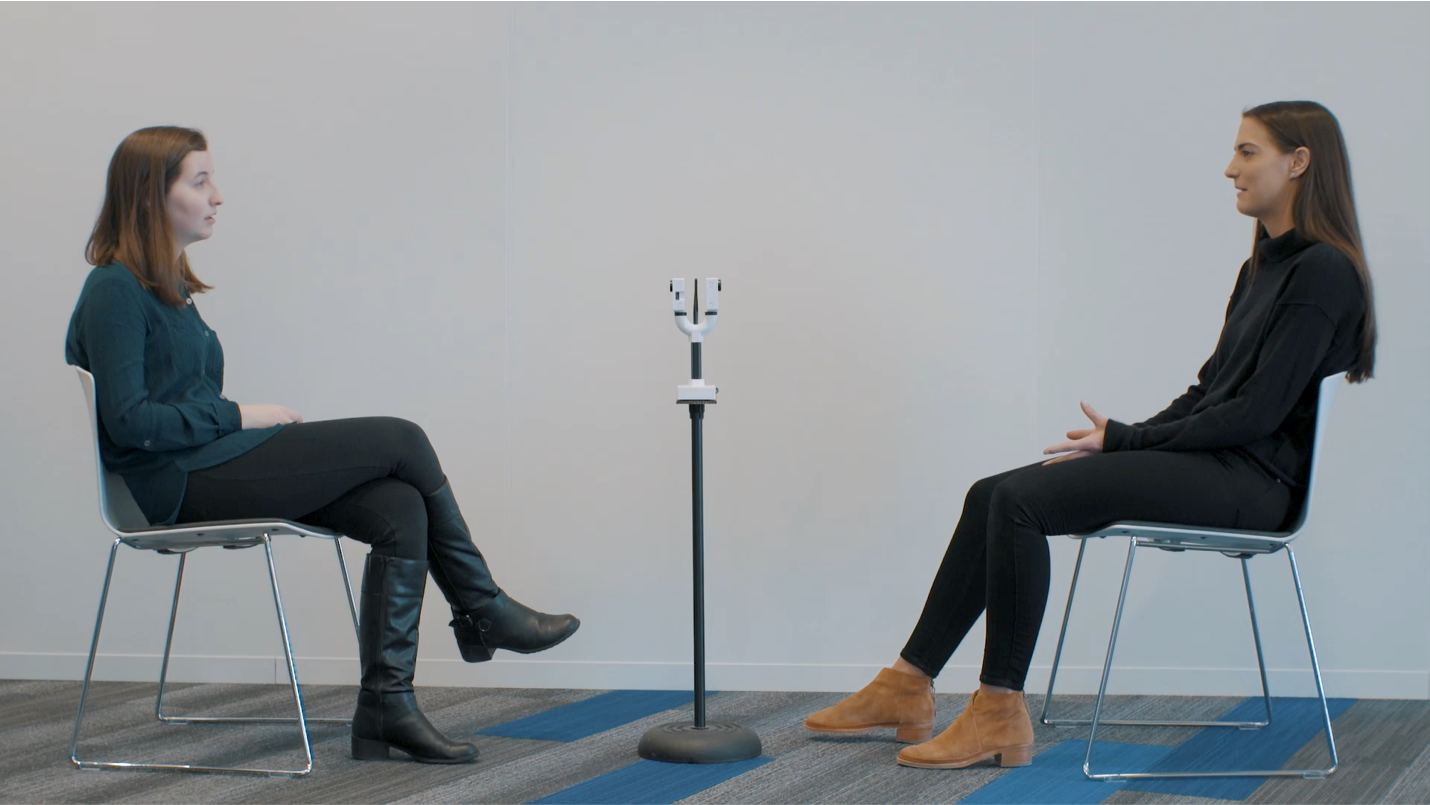
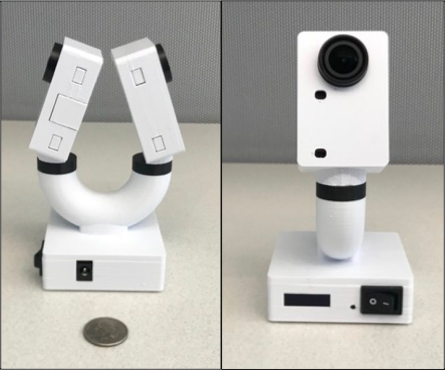
Naturalistic but instrumented. A custom dual-camera (BioSensor) captured synchronized conversational video from both partners while minimizing interference with face-to-face interaction. Left: conversation setting with a participant and confederate. Right: BioSensor close-up. From McDonald et al. (ICMI Companion). Figures from Center for Autism Research, Children’s Hospital of Philadelphia.
Pipeline architecture: temporal pattern encoding and feature construction
The computational pipeline, shared across both studies, treated conversational head movement as a sequence of short temporal patterns rather than as a small set of coarse summary statistics. Head pose was extracted from video to produce continuous signals for yaw, pitch, and roll, along with their framewise derivatives, yielding six signal streams per participant. Each stream was segmented into overlapping windows, z-scored to capture shape rather than raw magnitude, and assigned to clusters learned separately for each angle, producing a vocabulary of prototypical movement patterns.
From there, I constructed two complementary feature types. Monadic features summarize how often a participant’s windows are assigned to each cluster, yielding a bag-of-words histogram over movement patterns. Dyadic features encode something qualitatively different: not just what each person does, but what both people do at the same time. For each participant–confederate signal pair, I computed a co-occurrence matrix whose cells count simultaneous cluster assignments. Extending this across angles and cross-direction pairs yields a feature space that explicitly represents interpersonal coordination rather than treating each speaker’s behavior as independent.
Across both studies, the computational logic was the same: convert short temporal patterns into an interpretable vocabulary, then ask whether distributions or co-occurrences of those patterns carry meaningful social signal. This made the representation both data-efficient and interpretable while still allowing the model to distinguish individual behavior from interactional structure.
Beyond this specific setting, it provided a tractable way to represent relational sequential behavior under a limited observational footprint.
Developmental findings: head-movement patterns as age probes
In Head Movement Patterns during Face-to-Face Conversations Vary with Age (ICMI Companion 2022), I applied this framework to 79 neurotypical participants aged 5.5–48 and compared monadic and dyadic features for classifying participants as younger or older than 12 years. Dyadic features achieved 78.6% accuracy versus 71.4% for monadic features, and a regression analysis using dyadic features yielded r = 0.42 (p = 0.0001) between predicted and chronological age.
The dyadic advantage matters because it suggests that developmental signal is not confined to the participant alone. Age appears to shape not only a person’s own head movements, but also how a conversation partner responds in interaction. That makes the signal relational rather than purely individual.
The relationship between thresholded classification and continuous-age regression is also informative. Classification was more robust than exact age prediction, which is consistent with the interpretation that nonverbal communication stabilizes across development, after which within-age variation dominates finer-grained continuous prediction.
Feature analysis made these results interpretable. In the monadic setting, the most informative features occurred more often in the younger group, suggesting more frequent or more varied head-movement patterns. In the dyadic setting, many of the most informative features came from the confederate rather than the participant, indicating that developmental signal is partly carried by the interaction partner’s behavioral accommodation.
Autism classification and clinical nuance
In Predicting Autism from Head Movement Patterns during Naturalistic Social Interactions (ICMHI 2023), I applied the same framework to conversations involving 15 autistic and 27 neurotypical adults. As in the developmental study, dyadic features outperformed monadic ones, achieving 80.0% accuracy versus 69.2%. This reinforced the broader methodological point that social-communication differences are better captured in the interaction than in isolated behavior.
The dyadic classifier showed high specificity (93.3%) but substantially lower sensitivity (55.9%), making it considerably more reliable at identifying neurotypical individuals than autistic ones. The work is therefore not intended to be a diagnostic tool. Its contribution is a scalable computational method for studying subtle social-communication differences, not a clinical screening instrument.
A negative result is also informative here: simply concatenating monadic and dyadic features did not improve over dyadic features alone. That points to an open modeling question about how to integrate individual and relational behavioral signals without diluting the contribution of the lower-dimensional monadic representation.
Feature importance and interpretability
A common goal across both studies was to identify which movement patterns mattered, rather than treating the model as a black box. In the developmental study, I extracted the most informative classifier features and visualized the corresponding cluster-centered movement patterns, making it possible to interpret which angles, directions, and speaker roles contributed most strongly to age-group classification.
In the autism study, feature-weight analysis showed that movement magnitude was generally more influential than velocity, suggesting that the shape of how a person moves their head in response to a conversation partner may be more informative than movement speed alone. Among the three angles, pitch and yaw contributed more strongly than roll. These results connect naturally to socially meaningful cues: pitch movements such as nodding can convey agreement, attentiveness, or contemplation, while yaw movements can reflect disagreement, reorientation, or shifts in attention.
The current representation also points to natural extensions. Angles are modeled independently, even though conversational head movement often involves coordinated motion across multiple axes. Likewise, the bag-of-words and co-occurrence representation captures time as a distribution over short temporal patterns rather than as a full trajectory. Both were reasonable choices for interpretability and tractability, but both suggest clear directions for richer future representations.
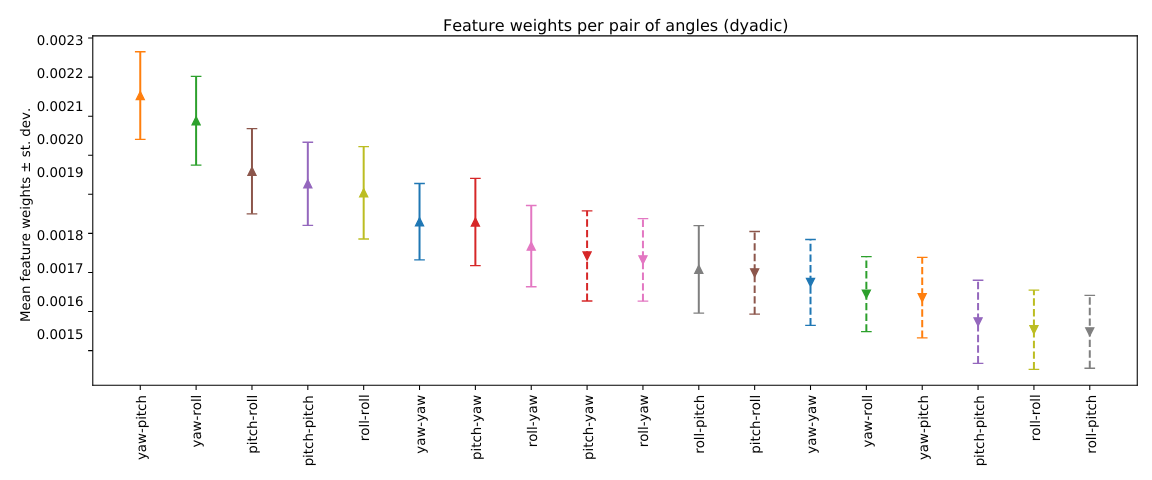
Dyadic feature importance across head-movement types. Mean and variance of SVM feature weights for dyadic features show that movement magnitude is generally more informative than velocity, and that pitch- and yaw-based relationships contribute more strongly than roll to autism classification. Adapted from McDonald et al. (ICMHI 2023).
Methodological contribution
This project sits at the intersection of sequential modeling, computer vision, and computational behavior analysis. The most interesting ML question it makes precise is not simply whether a classifier can separate groups, but how to represent relational behavior—what two people do in coordination over time—in a way that is interpretable, data-efficient, and usable in naturalistic settings.
The bag-of-words plus co-occurrence construction is one tractable answer to that problem. It makes interpersonal structure explicit, supports feature-level interpretation, and works with a relatively minimal sensing setup. More generally, the work shows that meaningful developmental and clinical signal can be recovered from unobtrusive social observation when the representation is designed around the structure of the interaction itself.
That modeling question is not confined to clinical or behavioral contexts. At a broader level, it is a problem of representing interactions rather than isolated individuals: learning structure from coordinated, partially observed behavior when the signal of interest lies in the relationship itself — a question that arises in any setting where the meaningful unit of analysis is a dyad or group rather than a single person.
Physiological Signal Modeling and the Origins of BioHCI
My earlier work on physiological signals, especially fNIRS, helped establish the methodological foundations that later evolved into BioHCI. What mattered most in this line of work was not simply applying machine learning to biosignals, but developing a principled approach to representing noisy, human-generated time series in a way that supports valid evaluation, reusable experimentation, and comparison across studies.
In User Identification from fNIRS Data Using Deep Learning, I studied whether resting-state fNIRS contains enough stable individual structure to support identification. Using data from 30 subjects, I constructed windowed statistical features over oxy-hemoglobin, deoxy-hemoglobin, their sum, and their difference after channel selection, filtering, and normalization, and then trained a multilayer perceptron for classification. The best-performing configuration achieved 63% accuracy relative to 3.3% chance, showing that even relatively noisy physiological data can contain meaningful subject-specific structure when represented carefully.
The resting-state setting is important here: the signal sufficient to identify an individual was present without any task engagement, suggesting that stable subject-specific structure was recoverable from the physiological signal itself rather than from task-induced responses. A second finding reinforced the importance of temporal granularity: accuracy degraded consistently as window size increased from 1 second to 90 seconds, indicating that the relevant structure was more recoverable at finer temporal scales. That emphasis on representation and temporal resolution continued directly into later BioHCI design.
This project already exhibits themes that recur throughout the rest of my work: representation before prediction, careful handling of noisy multi-channel signals, and attention to how evaluation design shapes what a model is actually learning. It also points to a broader implication that remains important today: if stable individual structure can be recovered even from resting physiological data, these systems raise questions not only about biometrics and authentication, but also about privacy, consent, and data governance.
At the methodological level, this work fed into the modular, subject-centered BioHCI framework described on the Systems page. It reflects a methodological stance that continues across my research: stable structure in noisy human-generated signals is best recovered through reusable abstractions for preprocessing, representation, and evaluation rather than through one-off task-specific pipelines.
That stance also connects to broader ML concerns about evaluation validity, benchmark design, and reproducibility. The subject-centered evaluation structure developed here — preserving independence across users rather than treating windowed samples as independent data points — addresses a leakage problem that affects many real-world ML pipelines and is not unique to physiological or behavioral data.
Research Outlook
Looking forward, I am interested in how representation learning can move beyond single-signal settings toward models that integrate multiple sources of structure in real-world behavior. Across my work so far, meaningful information has rarely resided in one variable alone: it emerges across channels, across time, across interacting people, and, increasingly, across different forms of observation. One direction I would especially like to pursue is how to combine individual, relational, and multimodal signals without losing the interpretability or specificity of each. This points naturally toward broader ML questions about multimodal integration, transfer across heterogeneous signals, and how structure can be learned when no single source is sufficient on its own.
A second major direction is learning under distribution shift. My work has already engaged this problem through cross-subject evaluation, zero-calibration inference, robustness to physical deformation and environmental interference, and modeling in naturalistic rather than tightly controlled settings. I want to push further on the question of what kinds of representations remain stable when real-world conditions depart from the assumptions built into the training distribution. The evaluation frameworks developed in this work provide concrete, implemented testbeds for these questions: not just motivation in principle, but experimental settings for studying what makes representations remain stable under shift.
I also want to continue exploring learning from sparse signals and minimal hardware. A through-line in my research has been asking how far computational modeling can extend the capabilities of limited sensing substrates rather than relying on denser instrumentation. I find this compelling not only as a technical problem, but also as a design principle: systems are often most effective when they become less obtrusive, less demanding, and better aligned with the environments in which people actually use them.
Together, these directions define the research program I want to continue building: representation learning for structured and relational data, robustness under shift, and inference from low-observability signals in systems that operate within real human activity rather than interrupting it.